You May Now Proceed to “Overthinking”

This blog was a risk. This blog felt vulnerable and scary. But, this blog has also been freeing. I’ve gained a space to think and wonder but I still feel nervous almost every time I post something.

I haven’t posted in a few days (almost two weeks) because I’ve been angry and also buried in school work. Instead, I’ve been scribbling my thoughts in a notebook begging for a moment to make sense of everything. At the same time, I’m really craving a chance to just spew some (possibly) utter chaos and just leave it here so that it’s somewhere and I can move beyond it.

Here I go…

I’ve come to one of the biggest realizations of my life these past few days:

The system is only a system if you buy into it”

[Side Note: I use a lot or metaphors and write in cyclical notions. It’s because metaphors make space. That’s a double meaning. They allow me to explain myself and explore what I’m thinking when either I don’t have the words or I don’t want to confront the words. They provide a necessary element of distance while also providing direct insight into how I’m thinking and feeling. Anyway, these days I’m attempting to make metaphors work because then I don’t have to “own” everything just yet. I can make space and take space through one simple (kinda) conversation.]

What a troubling realization. Basically, life shattering. All this is to say EVERYTHING is socially constructed and things only have meaning if we allow them to have meaning. From grades, to language, to religion, and relationships the meanings we attribute to them and the agreed upon social understanding of these ideas are what perpetuate them. Another day maybe I’ll dabble in a conversation about race, gender, and sexual identity in a similar vein because the same logic applies. BUT, I don’t want to get into that right now.

Regardless, this whole sentiment makes me think a lot!

If I think too much, and allow myself to wander down that windy path, it makes me question if anything matters at all.  Not in a hopeless way, but in a curious way. If we can break down each construct and get to the bottom of all this thinking, underneath it all, we’re just people. I DO realize the danger of a statement like that!

But really, if I think this through enough it’s like nothing is actually real until we make it real. And in so many ways, making it real means attributing a label or value to what we’re experiencing. Remember, “The system is only a system if you buy into it”. This meaning making requires us to create and make sense of arbitrary distinctions and agree to attribute value or worth to them in order to reinforce hierarchies or beliefs that in some ways separate us and in other ways bring us closer together or build us up. Although, even when we’re being built up, it’s always in contrast to someone who is necessarily considered “less than” us. Otherwise, how would we reinforce these systems and structures?

So, it begs the question, if the systems only exists because we allow them to, then how can we say that anything is really real? And, if we’re ascribing to this perspective, and can rationalize that nothing is real, then clearly, nothing really matters. Okay, let’s say there for a second. If nothing really matters BUT we can’t escape the classifications and hierarchies (systems and structures) that are literally the foundational aspects of the word we live in, then does anything matter only because we let it matter? Are we simply learning to live as compliant beings and play our part in systems that we cannot change? Are we upholding the systems by performing our expected behaviors and not challenging our roles?

I’ll concede. Yes, there’s logic and order associated with the extent to which we accept and act out our roles and comply with the understanding that the world works in a certain “way”. But really, I can’t help but wonder what it would take to make it all stop for a second so we can catch our breath and realign our expectations and so we can take a good look at our world and consider what REALLY matters?

It makes my head spin!

The Sensational Appeal of Order and Calm

The title of this post comes directly from a piece I wrote earlier this week: The Number Stares Back. I wrote that piece quickly because the words and anxieties felt like they were bubbling over much faster than I could really handle them. Consequently, that’s not an unfamiliar feeling these days. Things just happen so quickly. And I can’t make it stop. I’m thinking about everything and ruminating over small aspects of each day. So much thinking! I CANT MAKE IT STOP!

Ordinarily, this feeling of “doing too much” doesn’t faze me. I’m notorious for “doing all the things” and doing them well. I don’t settle. So, what’s been most indicative to me that this feeling is different is the notion that I actually feel overwhelmed. Like REALLY overwhelmed. And, I don’t know what to do. And, all this is conflated with immense feelings of loneliness, feelings, perceptions and fears of being burdensome to others, and serious negativity that’s often repositioned through anxious energy as enduring positivity and enthusiasm (I’m faking it!). Paradoxically, my attempts to mitigate the accompanying feelings of any of these conflations often end up exacerbating another. How difficult?!?!

How do I explain this? It’s like, imagine that you’re running a race and each time you’re just about to approach the finish line it appears to be further way. And, since this is a race, you have on your “game face”. Nothing will stop you and you’re compelled to keep running because, after all, it is a race. Amidst this notion of racing is the adrenaline and anxiety that accompanies the “big day”. This helps you maintain your pace and endurance. Actually, in the case of endorphins, this feeling increases throughout the ordeal. The metaphor here, life as a race, isn’t a new one; we all know the saying “life’s a marathon, not a sprint” and we’ve read countless similar mantras. The idea though is that it’s applicable here too and more so because I feel like the race never ends!

So, I’m going a slightly different direction with this. I’m attempting to illustrate what it feels like to be unable to stop. I’m attempting to explain the conundrum and relative consequence of thinking so quickly, so often, so intensely and how this hectic, more appropriately chaotic, state is both tiring and illuminating. Mostly though, it’s really really really overwhelming.

If I were swimming, this might be akin to that precise moment right before you come up for air. The anticipation of a deep breath is quickly quenched by a satisfying inhale. However, if this action is repeated, for example if I were to quickly dart back under the water, then the repetition of anticipation and ascertainment may be associated with a feeling of never getting enough of what you need or incessant wanting. So, the gasp of air may be nearly enough to sustain your stroke and stamina but not to fully satisfy your desire. I’m trying to make this analogy work! I just want a full, deep, satisfying breath of air!

So yes, there’s an inexplicably sensational appeal to finding order and calm. However, my best attempts at capturing those moments of order and calm are often met by many obstacles I can’t yet overcome. And, as I relentlessly seek out this feeling of serenity I’m coming up against tall, sturdy walls of abruptness and urgency instead.

I WANT IT TO STOP!

The Number Stares Back

I used to keep the scale in the closet.

Inspirational post keep reminding me that I am more than the number staring back.

I ask, more what?

Inspirational posts are reiterating their messages of body positivity and healthfulness.

The number stares back.


I used to keep the scale in the closet.

Feminist blogs keep reminding me that my body is for me.

I question, how can I be more confident?

Feminists blogs are shouting the atrocities of body policing and fat shaming.

The number stares back.


I used to keep the scale in the closet.

OCD tendencies keep reminding me that control and discipline are at risk.

I think, what else can I control?

OCD tendencies are commanding their claim for necessity with the sensational appeal of order and calm.

The number stares back.


I used to keep the scale in the closet.

Today, my white scale, fixed, centered on the cold, wooden floor, keeps reminding me of the dissonance I’m experiencing around self-destruction and self-worth.

I demand of myself, what have I done?

My scale is engulfing me when it screams, “it will never be enough”!

The number stares back.

Absolutely Necessary

I love great conversations! The best are the ones that keep you thinking, and questioning, and somehow are relevant and applicable in other conversations days later. I really love those mogood-communicationments where you have to stop and think, “Is the whole world having the same conversation as me?” or “did they know I was just talking about this with someone else earlier?” Suddenly, what seemed like a “one-off” discussion becomes so much more than that. And, with each new perspective, each additional layer, you gain insights and ideas that inevitably shape who you are! It makes you think! I mean really think!

Anyway, a couple weeks ago, I linked to “Jew-ography” and I’m still thinking a lot about the important lessons I learned from my time exploring the Jewish community in Cape Town. My experience in Cape Town was iterative of and has been reiterated since then as, during every major transition in my life, I slowly established my Jewish communities and networks. In Cape Town, I was literally moved to tears by the comfort I found once I overcame my apprehensions and attended Shabbat services. It’s crazy how you can be so far away from home and still find spaces that are so familiar and so welcoming. Lately, I’ve been having a lot of conversations about religion. It’s been exhilarating to grapple with my own experiences and learn about others’ connections (or not) to religion and spirituality. This has been especially impactful in the wake of so much tragedy around the world.

When I was growing up, at every bar/bat mitzvah (including mine) there was this song that the choir sang and the lyric in the chorus was “you shall be a blessing”. By this logic, I guess, rather than being blessed you, individually, are the blessing to others (and presumably vice versa). So then, especially when I begin consider all the “adversity” I’ve experienced and also what I know of the experiences of my friends (and generally in the world) and then how I make sense of that ends up making no sense at all (*sigh*). I believe adversity makes us more resilient. Even in the face of adversity we have the opportunity to acquire resilience and find the good, the blessing, in each moment – each interaction.

Lest I digress further, for me, I do a lot of “Jewish things” “just because we always have”. I’m into tradition. I appreciate practices that are a daily reminder of my religion but specifically as it relates to my need for community and connection. It’s the only thing I know (My mom is a Jewish educator (as in runs her own religious school) and my parents met as Jewish youth group advisors). So for example, keeping kosher is super important to me because in the midst of chaos and the hecticness of every day this practice makes me stop each time I eat and reminds me of something that is so fundamentally important to my identity. So the “why” or lack of doesn’t irk me (although I do know why I just don’t think about it every time) because my intentionality is one of community and maintaining a connection to my religion and to other Jewish people. When I was growing up, my mom used to play me this song (I intentionally searched for the silliest recording I could find). That resembled the “connection” piece for me. And so far, it’s been hugely influential and necessary and real for me. For example (as I mentioned), in Cape Town and then again this year, it’s been the Jewish community that has been the consistent, redeeming, allows me to breathe deeply, and smile authentically even if everything else that day sucked, special thing in my life [side note: I realize I’ve written this exact sentence before but, it applies here too].

One essential aspect my experience of Judaism is the music and the associated energy/spirit- in Hebrew we call this Ruach. I’m sharing this (and the above examples) because it reminds me about (and represents) the energy and interconnectedness that what I feel when I pray and when I find that connection – but not always because sometimes it feels like I’m just going through the motions as they’ve been scripted and reiterated so many times before.  Which is why I go each week to services – I fear missing it!

This week, this Shabbat, I definitely didn’t miss it! I was overwhelmingly reminded how absolutely necessary my Jewish community is. The colorful, diverse, emotional, bright, warm, accepting community felt just right. Our voices collectively filled the room with praises and each of us was connected in song and in spirit.

Have you ever stopped to take notice of your body and noticed that you’re smiling so much and in that moment there’s practically nothing that could happen that could make your smile waiver? It’s more than just being content. It’s a sense of belonging. It’s something beyond choosing to be happy. It’s the understanding, the realization, that you’re exactly where you need to be. It’s being so present you don’t even have to remind and refocus your energies to be “in the moment”. I knew I didn’t want to be anywhere else. Even if I have to continually relearn this lesson, I know definitively no matter where I am in the world, no matter how hard I try to “do life” (which apparently doesn’t initially include Judaism) ultimately this one thing, this connection and energy , is a necessity, that simply (or not so simply) reinvigorates me each week and I cannot be without.

Wonderful Terrors

I have writer’s block. I can’t find the words or space or time to write about what I want. I’ve been journaling though because despite the craziness of finals and grad school, I can’t shut my mind off even if I try. What follows is an attempt to relieve and relinquish the swarming thoughts in my mind and reconcile some of the words I’ve been scribbling down over the past two weeks.


It feels like my words are shouting what I can’t say aloud:

I want to stop!

I want to feel less crazed.

I want to feel like everything is not urgent.

I want to be okay with doing nothing.

When will it/I be/do enough?

Is this sustainable?

WHY!?

Sometimes people ask me what would happen if I just stopped (stopped rereading/repeating, stopped planning and attempting to ward of unpredictability, stopped surrendering to my watch). Usually, they ask, “what’s the worst that would happen?”  I can’t answer them. I wouldn’t know. I don’t want to know. Instead, I prefer to go through the motions. 

For me, there’s solace in each predictable, planned moment of my day. Knowing each minute will be attended to assuages any concern that my thoughts will distract me.  It’s true that in life there are no counterfactuals but, that hasn’t stopped me from trying to anticipate each situation (and to some extent the various outcomes). It makes things easier to manage.  I need order, structure, and routines. That’s safe. That’s comfortable. It’s incredibly easy for me to rationalize and justify many of these behaviors because I crave that control.

An important, and incredibly influential, role model once said to me, “What wonderful terrors await you 😀 hehe!”. In response to her I said, “So, basically what I derived is that it’s okay to be scared. I hope that this fear will actually fuel me to make the most of this opportunity rather than cripple me. ” I hoped that the concoction of terror, excitement, opportunity, and the unknown that I was about to swallow down by choosing (and eventually coming to) this program would propel me and ignite something in me. 

I wish that I could give in to this terrifying and exciting time but instead I find myself consistently searching for a way out. Instead of embracing this fear I find myself tirelessly attempting to ascertain control wherever I can in an environment that too often feels unsupportive and makes me feel small (apparently that’s how you know you’re doing grad school “right”). So I need to fill my time. I need to over commit. I’ve written about this before but, it’s still relevant. I know it’s still relevant because I can confidently say to myself and others I’ve been “fine” for the past few weeks. But that’s not honest. 

Fine means I haven’t let myself experience any of what’s been challenging me. Fine means I’ve successfully occupied my mind with distractions. Fine means I’ve exerted sufficient effort trying to keep up appearances and be “productive”. Fine means I’m operating more like a machine than a person; I’m operating with the same level of energy and proficiency each day. The never satisfied need (more honestly the compulsion) to make to-do lists and accomplish everything (regardless of the consequences for my body or my mind) is keeping me grounded. But, it’s keeping me grounded. I cannot thrive. In the midst of crossing off each item and feigning fine I’m losing myself by simply, compulsively, chronically going through the motions just to make it through the day, week, month, year, etc. I think I’m trying to say, as soothing as this is, I’m not letting myself encounter any “wonderful terrors”.

The Intersection of Logic and Ridiculousness

Recently, I had the most amazing conversation with a friend. Imagine this conversation as if it were a route on a map. It started out at the corner of vulnerability and suspense. Then, it rounded the corner into an open lot of questioning and wonder. It meandered to a land of thinking deeply and differently. The conversation took a perplexing turn toward striving to understand contrasting and complex perspectives. Hours later, we contently (and brake screechingly) arrived at the intersection of logic and ridiculousness. One the lyrics in the song Maps – Fun Home says, “maps show you what is simple and true” (Click here for another great Broadway song about maps: A Map of New York – If/Then). However, in this conversation nothing seemed simple and true. The adventure we jumped into did not have definitive boundaries or expected outcomes. Even so, despite the many twists and turns, I didn’t feel lost! That’s how I know it was a conversation worth having!

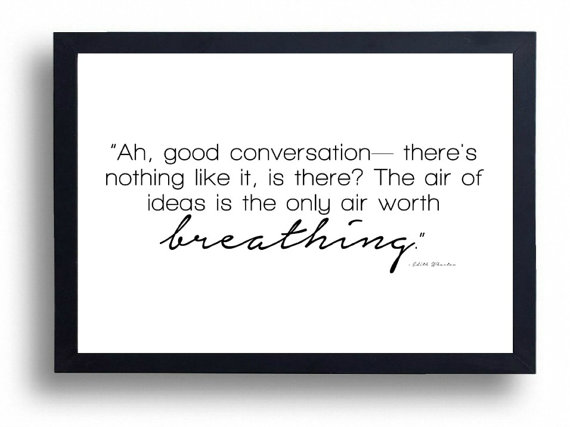
I was (and still am) swimming in my thoughts. But, the accompanying feeling of drowning or going off course wasn’t overwhelming; it was exhilarating! I was thinking so quickly my whole body was engaged. I was craving that!  It was like a switch turned my mind on and things lit up! My brain was entertained and invested in this discourse for hours contemplating the multiple pathways I might contend with as I navigated through this thoughtful, meaningful exchange. For those hours, I recognized myself. I felt comfortable and confident. It was as if life was breathed back into me. il_570xn-704413268_4vxg

I have to believe that’s what it means to be truly connected to someone else (speaking of connections… click here to read about “Jew-ography”!). The whole world could be moving on but you’re right there committed to that moment, that interaction, because this is so real and so personal. It’s that synchrony, that energy, that is so influential! I was reminded of what it feels like to be me. I miss that. I miss the space to think so intentionally and to be truly connected. I loved listening, struggling with, and accepting each perspective simply for how it moved and shaped the discussion. This was an inexplicably redeeming,  special, allows me to breathe deeply and smile authentically (even if everything else that day sucked) opportunity. I’m so appreciative!

Calling All Beautiful Brains!

Every year around the holidays, the body image/food banter begins. There are the fitness/health magazines that flood you with ways to cut calories before, during, and after the holidays so your family doesn’t “ruin” your diet. There are the online support and communities for individuals who face eating disorders and are challenged in a different way by food each day. And of course, let’s not forget, while many of us are worrying about how many calories we’ll eat and making sure we get in those extra workouts before the holiday to mitigate the damage, there’s the very real fact that food insecurity and poverty is rampant in our world. How ironic  (or disappointing, disgusting, humiliating, etc.) is it that while we’re attempting to limit ourselves and we’re faced with the “problem” of overeating on the holidays there are individuals and families who are, rightfully so, more preoccupied with wondering where or if they’ll have a holiday meal at all?

Untitled (Recovered)

A few months ago I posted a new profile picture (above) on Facebook (nearly days before I deleted my Facebook – still SO happy with that choice!). I posted the photo because I had a great day! The sun was shining, I felt strong, confident, and HAPPY! I was surprised because this photo received nearly the most likes I’ve ever had on a profile picture (second only to my Brown University acceptance post). Not only did it receive so many likes but also there were a lot of comments. Initially the positive vibes felt so good but after a short while I was perplexed. I didn’t post this photo to receive high praises. I definitely didn’t post it for people to comment on my body!

I already wrote about why I quit Facebook but one aspect of this is still on my mind. When we post things, who are we posting them for? Why are we posting them at all? Are we looking for approval? Are we sharing information/resources/insights/thoughts? Are we hoping one specific friend will see it but too nervous to send it directly to them? Regardless of our rationale, does it really matter? Once we put it out there, others decide how it resonates with them and so even if we posted something literally because “we’re happy, free, confused, and lonely at the same time” (shout out to Taylor Swift) that doesn’t really matter.

I said something to my mom about my concern regarding the overwhelming positive attention the photo (ie. my body) was getting. She told me (and her words pierced my mind) “if you gained weight they would still be talking. Just, they’d be saying it behind your back”. Ahhh, my body is for me! I don’t understand how it became anyone else’s prerogative to police of approve of my body. I don’t know why people feel that they have the right to fixate on another person’s body. Why they feel compelled, and they feel good about it too, to tell you how “great” you look! Clearly skinny is beautiful and fat is shameful and shameful things are discussed in private while beautiful things are praised publicly. Why did I have to look  “holy skinny” so that others would “like” my photo? GOSH!

At this point, I want to share a resource: How to Talk to Your Daughter About Her Body. The most poignant thing I’ve read recently about “body positivity” and “self love” came from this article, “How to talk to your daughter about her body, step one: Don’t talk to your daughter about her body, except to teach her how it works.” Bottom line, beauty is far more complex than what we see on the surface. In this piece, Sarah Koppelkam gently encourages us to “Remind your daughter that the best thing she can do with her body is to use it to mobilize her beautiful soul.” In fact, when I read that, I felt like I’d heard something of a similar sentiment before!  I was right! One of my favorites, Cristina Yang (shout out to all the Grey’s fans – for more quotes click here!)  said, “Oh, screw beautiful, I’m brilliant. You wanna appease me, compliment my brain!” YESS YOU GO GIRL!  Except one caveat, can’t I have a beautiful brain? Why does our perception of beautiful have to always relate to the outward appearance of our bodies? Why can’t we compliment each other about things that have nothing to do with our bodies? Furthermore, why can’t we separate our self worth (or other people’s perception of our self worth) from the numeric value that appears on the scale or the clothing tag?

Recently I saw this tweet from Realize Your Beauty in response to a twitter chat about maintaining health & happiness over the holidays. The question was: “Why are the holidays sometimes triggering or stressful?” The response: “Seeing family & friends you haven’t seen for long periods of time-Feeling you have to look or ‘be’ a certain way around them. This really resonated with me. I noticed that I was worried about that too. I just hadn’t been able to articulate it.  [side note: I sort of feel like this twitter chat in itself was triggering or stressful – or could have been] Going home means that I will have to endure questions and comments like “you’re really keeping the weight off!” or “how much weight have you lost?”.  AND obviously we can’t leave out the drama and hassle of Black Friday shopping. At this point, these are the last things I want to hear or do over the holidays. I want to draw attention AWAY from my body, not toward it. It’s frustrating and it makes me worried to go home. In fact, I didn’t notice the stark difference in my own body until a good friend brought it to my attention. These two photos are pretty telling, to me, but what I don’t feel they indicate is “beauty”. [side note: remember, I’m great at keeping up appearances, so while I may appear happy in these photos the contrast, and the reason I’m sharing these images, is more important than the emotion they seem to portray]

My point here, is simple. No overthinking involved (I wish!). My body is for me. It is not for anyone else to comment on unless I give them explicit permission. My body is not for you to approve of or to disapprove of.  Furthermore my body is not for you to speculate about “how I did it” or for you to judge or envy. I am not your success story. I am not your inspiration. [side note: watch this because Blythe Baird says ALL this way better than I could] For just a moment, please consider how telling someone they “look good” or inquiring about their weight loss can be triggering or challenging for them. It’s just uncomfortable. While likely it’s meant to be a kind gesture, a compliment, it can be harmful, embarrassing, or upsetting. Instead, focus on complimenting that person on something that has nothing to do with their body. Perhaps, their mind!

All I ask is that we cultivate the space, time, and the intentional energy to recognize how each person is different and how each person is perplexingly beautiful in their own way this day and every day.


Distracted Days

Oh My Gosh! I think too much! Lately, I’ve been getting so lost in my own thoughts I have barely been able to do anything else. I try to read and find myself flipping through the pages arbitrarily highlighting, giving the appearance of reading, but not reading at all. I’m so unfocused. All too often reading becomes “reading” and I find myself hopelessly wrestling with my own thoughts while simultaneously encouraging myself to focus. Always.

Sometimes it feels like I’m in a room and the walls are all my thoughts. If I could find some way out, a way to break down the walls, a way to push past the barriers that are my thoughts, I’d escape into fresh, crisp air. I’d be able to breathe again. Breathing fully, breathing deeply would feel SO good! I miss that.

I’m just thinking too much about everything! I spend too much time reconsidering a conversation with a friend, trying to decide when to send a text so it won’t interrupt people, rereading sent emails for typos and potential misinterpretations that cannot be rectified anyway, worrying that what I submit is barley good enough (that I can only fool people for so long – so therefore rereading and questioning myself until I make myself literally sick), observing and responding to my perceptions of social dynamics, I could go on and on (clearly)! I’m distracted. In one word, #done.

I want to slow down. I want to pull up on the breaks and tell my head “STOP”. I grapple constantly with this paradox, when I’m not working (and I’m doing something for me) my mind is spinning thinking about all the things I need to be doing.  And then I start thinking faster, allocating every minute and attempting to convince myself it will be okay. It feels like a frenzy, like if I don’t harness my thoughts I won’t be able to turn off the anxiety. Conversely, when I start working I can’t even focus on what I’m working on because I’m thinking about a million, minimally important, other things.  So, I think I should flip a switch in my head then maybe my brain will flip-flop.

However, this overthinking isn’t all bad. I’ve realized that I want to “think” for the rest of my life.  I want to be a researcher. I want to explore, question, seek to understand, make mistakes, try again, discover, disprove, and learn every day. That’s what researchers are, they’re professional intellectuals (but we’re not getting caught up in terminology). Researchers think. They wonder. So, it seems only natural, pretty fitting, that I would arrive at this aspiration. So, then, how do I get there?

Making Sense of This – Labels

Recently, I read Judith Butler’s Undoing Gender  (twice – yup that good!) and since then, I’ve had a lot on my mind. Well, admittedly, I always have a  lot on my mind but reading this text came at an aptly appropriate time. I’ve been grappling with words like “labels”, “identity”, “recognition”, “reality”, “acknowledgement” (different from recognition), “ownership”, and “desire” and this text just happened to put all these influential words in conversation with each other. Butler’s words, and subsequent discourses I’ve had about the text, said a lot of what I needed to hear and also hoped to hear. It’s been exhausting and cyclical to contend with and attend to these complicated thoughts. What follows will be my best attempt at making sense of this all. Most likely, I won’t resolve anything in the next ~1200 words and I’ll probably conclude with more questions than answers. But, that’s the beauty of wondering!


One quote in particular from the text has been ringing in my ears: “life histories are histories of becoming and categories can sometimes act to freeze that process of becoming”.  I might not need to say anything else about this quote. I could just leave it to simmer and settle with each person how they feel it best resonates with them. But, let’s think this through. Initially, (I’ll comment on this quickly because I could write forever about this) I understood this quote in relation to meaning and value associated with understanding how where you’ve been and where you’re going align. Basically, realizing for yourself what you’ve accomplished, experienced, and learned is instrumental to understanding who you are and why you’ve become this individual. Our experiences shape our future decisions and those decisions in turn shape us.

Moving on, in my interpretation of this quote, I regarded the word “categories” as synonymous with “labels”.  Writing about National Coming Out Day was my first stab at I grappling with the difficult but also empowering nature of labels.


Here are a few highlights from that post:

“We question “are our identities valid enough to be recognized on this day?” or “have we struggled enough to deserve to participate in National Coming Out Day?” Here’s where it comes back to labels. We decide the meanings we attribute to these words and then we judge. Why should one person who identifies one way fear so violently speaking their label? Owning their identity?”

“Our labels are both constricting and empowering when we first speak our truths. However, once society gets a hold of them, we’re leaving our words to be interpreted differently with each repetition of who we are.”


As I was reading Butler’s text, I was really caught up in this idea that all too often, our labels aren’t for us. Rather, they’re for others to make sense of or, frankly, cope with something that they perceive is different from the norm.  Lately, I’ve been feeling like labels and categories act to regulate the unfamiliarity that is associated with identifying as anything that is perceived as “other”  since we cannot locate other identities in the confining, typically binary, categories we are accustomed to. This is particularly interesting to me since many of my intersecting identities are both invisible and categorized as minority identities. [side note: I want to be careful here about how I represent and use intersectionality. I just want to note that the word “intersectionality” is often tied up in white feminism. Not a bad thing. I just want to consider and attend to thoughts about who is included and what assumptions accompany the use of that word.] In so many ways the responsibilities and opportunities available to us are aligned with society’s expectations for us based on our identities. This can have so many unintended and detrimental consequences.

And now, the question must be asked. To what extent do we really define our identities for ourselves?

Simply (although it’s not simple) all we really want is to be recognized for who we are. We have a desire to be acknowledged for who we are. Even the possibility of being seen for who we really are (maybe “becoming”) is desirable. What’s hard to grapple with is that for some people whose identities “violate” the norm their desire, and their wants and needs, are effectively put on trial. This trial, of sorts, serves to both normalize what is seemingly not normal and to assist or compel those individuals to ascribe to societal norms that most closely match their identity so they can gain access to services. I’m thinking here about transgender individuals who must submit to a diagnosis of Gender Identity Disorder (GID). It’s really a way that others deal with what is unfamiliar to them.

Mental health is great example of this. Often when people seek out services for mental health they report feeling relived even if initially the task of seeking support felt insurmountable. I think this relief comes from knowing that what they’re not alone. The possibility of fitting in even through the act of feeling or being ostracized is comforting. The existence of a community is enticing and soothing. Even just the fact that someone “gets it” or “believes them” can be relieving. The anxieties they anticipated feeling often diminish with the presentation of a diagnosis or the potential for better days (maybe this is a different type of validation?). But, at the same time, I can’t help but think about how accepting, announcing, or even seeking out, labels and consenting to this type of “normalization” (as in, it’s okay to struggle with mental health as long as we can call it something) and this categorization is one way an individual’s desire (also feelings/experiences) are simultaneously tested and validated. It is ironic to me (but really I want to use the word infuriating) that the “reward” or “accomplishment” for successfully proving the reality of your experience by subjecting yourself to someone else’s conclusion that your desire, or even prior to that your struggle, is authentic and persistent enough, is to be granted a diagnosis that qualifies them as disordered.  In a way, and sort of on the other hand, this diagnosis makes the person “intelligible” and grants them access to services and allows them to function in society. Their life is now understood in society’s terms and that makes their life “okay”.  This text exemplified for me how exclusionary practices, ie. a diagnosis (I ALSO MEAN HERE LABELS AND CATEGORIES) can be masked as inclusive and even medically necessary. I am troubled.

And to my point about who defines our identities, all too often it feels like autonomy is taken away from an individual and a person’s life is qualified and determined for them by restrictive practices that are contingent on an individual’s desire being qualified by someone else! Like, we have to convince people in power that certain aspects of our life are REAL. Because, if they aren’t real then how can we “find” ourselves in this world?

Another question I have then is, what about those whose struggle isn’t as easily visible? By this I mean, what about the minority identities we haven’t even TRIED to ignore (or oppress) and “normalize” yet because we haven’t even recognized them (think like hierarchies of minority identities here)? So, for those individuals, the possibility of being recognized at all is the more pressing issue at hand. That’s a different struggle.  If those people can’t see themselves in our world (ie. media, books, music, etc.) and find their community and if their struggle has yet to be recognized how might this persistent inferiority and feeling of being “unreal” or unrecognized make their oppression, their struggle, their voice that much harder to see and hear? And finally (for now) how does our own self-recognition factor into all of this? If we cannot “find” ourselves in the categories currently assembled and a remaking of the categories doesn’t seem possible then our quest for existence, figuratively, must lay dormant until others determine our eligibility for recognition. If others, society, won’t recognize us then how much more impossible might it seem for us to recognize ourselves and feel confident (rather than shameful) about our identities and who we are?

So, back to that quote… if “categories freeze that process of becoming” how can we overcome this debilitating desire (I would even argue necessity) in our lives to realize our true selves and recognize and respect each person for who they completely are?

So many thoughts! So many questions! I’ll keep thinking about it…

Confessions of a State School Ivy Leaguer (Part 1)

Some notes that I think should precede this post:

  1. I have been trying to write this for a while but I can’t seem to “finish” the post. It’s making me anxious to keep editing and rewriting so there will likely be a part 2 (at least). This is a starting point. We all have to start somewhere.
  2. I never thought I’d amount to anything better than state school (whatever that means). I feel like I was always “expected” to go to a public university. That being said, I LOVED UConn. My entire undergraduate experience was truly incredible and unexpectedly unbelievable. I learned SO MUCH! I grew so much. I’m incredibly proud to be a UConn alum and wouldn’t change a single thing about my experience.
  3. A part of me feels like there’s a lot of expectation for me to succeed here and not only represent myself well but also represent UConn well. It feels like any performance that is less than exceptional is unacceptable. I carry this burden (partially unwillingly) but also proudly. A part of me wants to prove I can do this. But it’s also a lot to deal with, especially when things aren’t going nearly as well as expected.
  4. Brown University isn’t a bad school. This writing is reflective of my experiences here NOT the institution itself.

When I was first deciding to come here, I had to confront a lot of my own insecurities and worries. I had to convince myself that my experiences and my aspirations aligned with the program I was accepted into. Essentially, I had to convince myself I was good enough, smart enough, intellectual enough to be here. Impostor Syndrome is real ( I didn’t know that then). Impostor Syndrome makes you work harder at everything you do while simultaneously forcing you to undermine and question your accomplishments by comparing yourself to your own perceptions of who and what is worthy of an “Ivy League Education”.  Basically , it makes you feel like all your accomplishments are a consequence of luck or circumstance. Basically, it makes you feel like YOU didn’t earn or deserve your opportunities or recognition. It makes it easy to prefer to be acknowledged as “mediocre” because then you don’t have to confront the disconnect between how you view yourself and how others perceive you to be. The best example of this I can recall, from my experience, is when an outstanding TA once said to me, “It started from my confused reaction to seeing such amazing things in you and also seeing that you didn’t see those things. I wondered to myself how things might change for you if you could see yourself the way I saw you.”  These words were super powerful for me!

Surprisingly, everything that challenged me about coming to this school (with regard to my own intellect, ability, and how “deserving” I was of this opportunity) became mostly obsolete (I realize that’s an oxymoron) once I got here. Admittedly, now (hindsight is 20/20), I NEVER could have predicted the real disappointments and challenges I’d face at this “elite” institution. That’s super frustrating! An advisor once told me that in life there are no counterfactuals (YAY economics!). He was super correct. Even when we think we’ve played out every alternative and every “what if” the truth is, we can never anticipate what we might experience and that reality coupled with the daunting feeling that once we choose we can never look back makes these decisions even harder.

In my opinion, Brown University oversells the name and undersells the quality. It’s one of those things you’d never know or think of until you’re here. No wonder I didn’t consider this! That’s the beauty of the signaling power of Ivy League universities. We find ourselves in these privileged spaces that are conceptualized as incredible and exceptional. [side note: taking a second to acknowledge there is privilege here regardless of how it’s created and maintained] This privilege is reinforced by how others think about and imagine “Brown University”. The thing is, I feel like this is a front. Because, the education I’m receiving doesn’t much different (certainly not better) that what I received at UConn. In fact, I recently found out that the professor I was so exited to do research with is collaborating with some of my professors at UConn on a few projects! So, in the world of academia everything is relatively interconnected. The name holds power and is desirable to employers BUT that’s probably and mostly because they don’t know any better.

I have yet to experience conscious conversations across or between difference. The kind of conversations where we separate the message from the messenger and critically consume what people are saying with the intention of crafting a collective learning space. I have no problem being challenged or having my perspective better (or differently) informed by additional viewpoints, opinions, experiences, or questions. I’m pretty sure that exchange is called learning. What I do have a problem with is feeling small. I have a problem feeling like I am constantly being judged, like my worth is decided before I speak based on anything I’ve said before, based on how others have interpreted my contributions, or what my peers believe to be my experience, intentionality, or privilege.

I absolutely realize the policy world is messy and challenging! I get that. What I didn’t expect was to confront this environment in the classroom. I expected to be exposed to a constructive, collaborative, communal, safe, eclectic learning space. Instead, what I walked into (and keep coming back to) was a condescending, unilateral, opinionated, inflexible, tense environment that is dominated by a select few voices that we’ve collectively put on a pedestal and allowed to be privileged in our space.

I’m tired of talking myself out of participating or preemptively convincing myself that my contributions are worthless (so others don’t do it for me). I know that I’m smart enough and intellectual enough. Those concerns may once have been my foci but that’s not the problem here anymore. Now I’m more preoccupied the toxic space we’ve created where I feel small and insignificant. It’s a space where I feel like my opinions don’t matter and my contributions are only considered to the extent that they can be criticized. The thing is, nobody is asking me my opinions – hence this blog! I realized recently, if I didn’t put myself out there, I’d never be heard because I’d never be invited to speak. Why is that? What does this say about our class dynamic? What does this dynamic indicate about whose voices and who, specifically, is respected, privileged, heard, or acknowledged?

I feel like I left what I knew and where I felt entirely comfortable. When I left, I jumped, deep, into something that was built up to be so amazing and stimulating. That basically left me with farther to fall. And I went because they pushed me! [side note: I’m really trying not to be mad about how forced this all felt] I left something so great for what I presumed (and certainly others presumed) was better.  I guess you can’t know or truly appreciate what you have til it’s gone.

Overwhelmingly, Brown University hasn’t met my expectations.