Today I Could Breathe!

I  feel like most of what I write is critical or negative. I want to take space to acknowledge the positive when I can. That’s important. That’s probably called, or may resemble something like, balance.

So, today was a good day!

A few weeks ago, I wrote about “owning this” and talked, generally, about how I’ve been experiencing some tough stuff and what that feels like. Those challenges are still incredibly real. They’re pervasive and unbelievably difficult. They’re even a bit dangerous in the ways they present themselves. [It’s a huge accomplishment for me to recognize and state this – just saying] Since then though, I’ve had some amazing conversations with friends and mentors.  I realized the utility of a support system in a different and more meaningful way than I have in the past. I appreciated my friends who created a space where I could articulate how truly miserable, scared, and uncertain I’ve been feeling. I privileged honesty and speaking my struggle in spaces where I felt safe.

I really hit a low point (I’m sill very much there) where I felt out of control. It’s like you know rationally that the behaviors you’re exhibiting aren’t healthy but you can justify them, contort them, and separate them from “you” right up until the moment when you can’t anymore and then the reality, gravity, and urgency of the situation feels so heavy, so crushing, it’s unbearable to attend to or face. I didn’t have the words to argue when my friends suggested I needed some support. It also wasn’t a time that I was asking for support. [you know you have amazing friends when you don’t need to ask] I’m pretty sure that when you get to such a defeated place, the arguments against seeking some help don’t hold water anyway. At the same time, though, I didn’t want to face it. I felt like if I did nothing in response to their concern that it wouldn’t be real. If I could keep avoiding it then, maybe,”I” wouldn’t need help. Turns out, the effort I spent avoiding all of this was, perhaps, more cumbersome than facing these struggles head first and bringing them into the light.

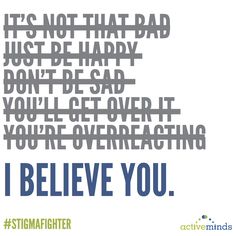
This past week, I heard a lot of things I really didn’t want to hear but I also realized the importance of both seeking out and receiving support. Throughout all these conversations two statements have been super influential for me: “I believe/hear you.” [validation] and “What do you need [from me]?” [support]. However, aside from just hearing these words, what’s been essential has been how I’ve responded to these statements. I accepted my friends’ feedback, their care, their warmth, attention, love, and guidance. Previously I didn’t want to respond to their outreach. I didn’t want to acknowledge their concern. What was different this time was that I shared my space, made myself vulnerable, and felt the true reciprocal nature of friendship. Specifically, I learned how necessary it is to allow or welcome [I tried “let” but it seemed too tied up in oppressive language, like laying down and “taking” their help] others’ supports. You don’t have to face this all alone. Asking for help or accepting it represents a different type of strength. It more closely resembles self-awareness and demonstrates that you know how to harness and leverage your resources in a way that lets you present your best self each day.

So, this week I did some evaluating and made some important, necessary decisions  (with the help of some amazing friends and a little motivator called accountabili-buddies [in other words, my friends getting on my case – because they care]). The interesting thing is, when the clouds parted and the sun shined through [that’s my interpretation of  how it feels the moment you experience relief – when you realize everything is not hopeless and things will in fact be okay, with some work and a whole lot of “next steps”] I acknowledged how seriously deep and detrimental this struggle has been.

Acknowledging and naming this, owning this, has been one of the most difficult and also inspiring and empowering things I’ve done in a long time. So, today was a good day. Today I did something so incredibly scary but also so necessary. I did something specifically for me. And many of the anxieties I had were lifted when I realized it was okay to not be “okay” and that for even an hour I didn’t need to spend all my energies on keeping up appearances. I could be genuine and admit my personal truths. Recognizing myself in this moment [even when this version of “me” feels so unrecognizable] had a positive impact I wasn’t prepared for. Embracing support didn’t feel as scary or weak as I expected it to feel. Rather, it felt reassuring. I felt like I could finally breathe today, like I could focus today. Today I felt worthy and (recently) uncharacteristically energized.  I felt light and most importantly I felt safe.

Thoughts on Relationships and Validation

Today, I’m tackling one of the topics on my “Things I Want to Write About” list: relationships and validation. This post isn’t about how great it feels to be told I’m right or consistently needing my ego stroked.  It’s about recognizing the power of and my appreciation for the friends in my life.

Months ago, I wrote the following important (to me) sentences:

“Relationships are among the many tools in your toolbox. They serve a purpose and they’re necessary to build your complete self”

That’s where I’ll start. This past year, I’ve learned a lot about relationships. I’ve learned to let people get to know me and I’ve started to understand and truly appreciate the necessity of reciprocity in friendships. I’ve allowed myself to be just vulnerable enough that I can accept others investment in me. Rather than pushing them away or putting up high walls, I’ve shared pieces of myself to add to the foundation of our relationship. Together we built something wonderful and soon I was able to feel how influential these investments were. In a year, I learned the meaning of true friendship and I’ve found my “people” (because why shouldn’t we reference Grey’s Anatomy wherever we can?!). I gained friends who likely know me better than I know myself and somehow, they always know the right thing to say to make everything better (or at least manageable for a moment).

Twice recently, I’ve had friends thank me for allowing them the space to “get enraged”. That’s the reciprocal part! That’s when I realized again that validation, active listening more precisely, is an essential aspect of friendship. I didn’t have to have the answers. I just needed to listen, acknowledge, and then ask what they needed from me. That shift from trying to “fix” the problem to simply supporting a friend has meant so much to me. It means that we can admit that sometimes the solutions are hard. We can respect and acknowledge each individual’s needs. Sometimes “I hear you. That sucks.” and saying or hearing nothing more is more powerful than whatever advice you could spew or pretend to listen to in the moment. Other times, our friends are our first line of defense where we can leverage our networks and share experiences and resources (when they are asked for of course. Consent is important!).

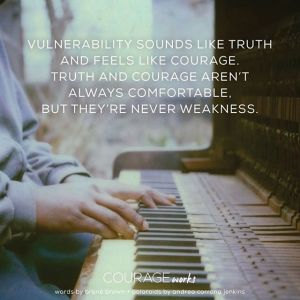
An interesting element about validation that I don’t think I initially realized is that in order to be validated, you have to share parts of  yourself – introduce people to the “real you”.  That means, you must have the tough conversations and sometimes let down walls or cross boundaries. You have to move past small talk. The benefit is, when you let the right person “in” you can experience the beauty of feeling truly cared for and important to someone. And, that’s all we can ask for some days. All we can hope for, all we can expect, is that we are important enough to someone and that our relationships are dynamic enough and salient enough to weather the storm and anything we might encounter.

This year, I’ve learned to love and rely on these relationships. The first time I realized how influential these friendships are was when a mentor, advisor, teacher, and now friend said to me “I hope you get everything you want”. That was one of the first times I felt genuinely supported without any external expectations. After I heard that, I smiled and felt like I could do exactly what I wanted without letting anyone down.  I can’t explain why that interaction touched me so significantly but, (at the risk of sounding cliché) it changed my life. So, since then I’ve been seeking out more meaningful moments like that. I’ve been searching for the spaces where I am heard. I’ve been wanting more friendships that change my life and warm my heart.

So, yes, validation feels good. It reminds me that relationships are necessary and that I’m not alone. It reminds me I CAN ask for help and, I don’t have to put up a front or appear to always be “okay”. Together we can share the true privilege of supporting each other – a privilege I like to call friendship. 

I Believe You – Color The World Orange Day

Today is November 2, 2015. It’s also Color The World Orange Day! Color The World Orange is an annual event held the first Monday of November to spread awareness of CRPS/RSD.

RSD, which stands for Reflex Sympathetic Dystrophy, is something I’ve lived with each day for more than 10 years. It’s a chronic pain condition. Basically, my nerves constantly (that means all the time) signal to my brain that I am experiencing pain in both of my legs from my toes to my thighs. The cycle never stops. That means, I live in pain all day, every day.  When I tell people this, I usually get the following questions/reactions:

  • “So how Reflex-Sympathetic-Dystrophy_1024x1024can you do ALL those things?”
  • “Wow that’s so impressive that you’ve accomplished so much even with this condition”
  • “Does it really hurt all the time?”
  • “Is it a psychological thing”/ “Is it all in your head?”
  • “It must not be that bad.”
  • “Can’t you just take medication?”
  • “You don’t look/act/seem sick.”

These statements are so incredibly frustrating to hear! My illness does not define me but it6c8e3bea9c73a0237d96592aaa02a506 is a huge and REAL aspect of my life. Instead I’d rather hear “I believe you”. Living with an invisible illness means that if you choose to tell people about your condition you constantly have to convince people that you’re struggling. Why is that? Why do I need to prove myself to anyone else? Similar to mental illness, chronic, invisible, physical illnesses are challenging to confront each day.  And when you identify with so many other things (yay intersectionality!) in addition to your chronic illness those who judge have a hard time fitting the pieces of your life together. Apparently, if it doesn’t make sense by their logic, it must not be real.
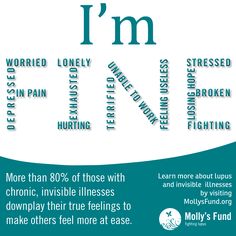
For a9490d6128d485966fed12d135823d23so many people living with chronic illness, we put up a front. Each day we go out into the world attempting to convince others (and ourselves) that we’re “fine” or “normal”. We have to, because we cannot allow our condition to control our lives or confine us. We can achieve and be excellent despite of or in the face of our chronic condition. Each day, we face a demon that wants us to stay down. It’s a demon we have to overcome. But what’s challenging is that even when we give off the appearance of being “fine” we’re struggling.  And then, if we’re successful, people assume we are fine. What complicates this is that once they assume you’re fine they have a difficult time hearing that you’re not. And when they do, their disposition toward you turns to pity or astonishment. The truth is, if I were to be honest about how much pain I feel each day it would likely make others uncomfortable. When I do tell people, they’re impressed by me. Don’t be impressed by me. Please. This is just who I am. We all have things that challenge us and shape our identities. This is one of mine. Instead, please accept my story and take this as an opportunity to learn more about the multiple dimensions of me. I live in pain each day and I’m incredibly good at putting up a front. Sometimes this gets me in trouble because I’ve gotten pretty good at ignoring my physical (and sometimes mental) obstacles in order to live a “normal” life and do everything I expect for myself. Sometimes that makes me work harder and push myself more. I can’t allow my pain to rule me. I have to literally triumph over pain and then some each day. The extra bit is to prove to whomever that I am more than my diagnosis and that my accomplishments are above and beyond simply “in spite of my condition”.

As I mentioned, when people find out you have a chronic illness their disposition toward you changes. Your accomplishments (the ones others use to craft their opinions of your success or worth) are elevated because we extend sympathies to those who “own their struggle” or because we can’t relate and we feel uncomfortablewhat-is-a-spoonie so we attribute praise. I’m just me. I’m one ordinary person with this specific challenge and I’m here to say it’s a constant part of my life but it’s not the only part of my life. I’m a Spoonie. In some ways, I need to be constantly aware of my daily obligations so I don’t burn out. Burn out is real. Running out of spoons is why I often “quit” at 9:30 PM these days. But that’s my reality.  And, all you get to do is accept that and support me. You don’t get to judge and decide for yourself based on my actions how severely I’m suffering or how real my pain is. You don’t get to decide for me if I’m making this up. You get to listen and validate. And gosh! Validation feels so good! Validation sounds like “I believe you”. It sounds like “what do you need from me”. It presents like genuine understanding.
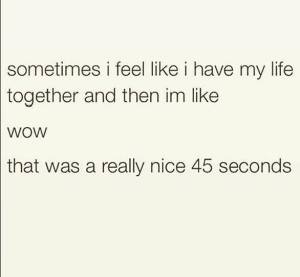
Two Words: Personality and Authenticity

There are two words that I can’t quite wrap my head around recently: “personality” and “authenticity”. When I googled these words, I got the following definitions:

Personality: individual differences in characteristic patterns of thinking, feeling and behaving

Authenticity: the quality of being authentic. So then authentic means, genuine or real.

So now let’s think this through. Individually first and then together. Warning: what follows is the epitome of overthinking. This is about to get messy and incoherent really fast. Be prepared!

The reason I’ve been thinking so much about personality is because I’ve been hearing two phrases over and over recently: “that wouldn’t work for me” and “you do you”. This has been important to me because both responses seem really dismissive and minimizing to the other person. Personality is tough to navigate and it’s always changing. People judge our personality the minute they meet us. (More about this when authenticity is brought into the conversation.) And then, when we think about the definition and consider our patterns of thinking, feeling and behaving it’s hard to delineate which informs which. In an intense moment we might respond impulsively and then be reminded later (by ourselves or someone else) to “think before we act”.  Sometimes we’ll blame this kind of behavior on temperament. Conversely, we may think (possibly too much) about a choice before we behave but no matter how much consideration and attention we give to a decision we may not feel confident or like we made the “right” choice. And all these things (yes, feelings too) create our personality. We likely all can recall a time where we felt like our actions were in conflict with our values or what we thought was correct. It’s like your insides, your personality, are splitting and that’s partly because we all have a conscience and rational thinking. So then, how does consciousness or morality or even mindfulness play into the equation?

ENOUGH! When I googled “personality” I got 305,000,000 responses in under a minute. I also realize people write entire books, courses, etc. on this and I could reasonably go on and on confusing myself in my own negotiations and wonderings forever if I wanted to (it happens ALL the time!). Moving on…

Now for authenticity. Being genuine. If you were to look up genuine, you would find words like “real” or “honest”. The first things this makes me think of (aside from the retail industry) is Brene Brown. However, that’s not what we’re directly talking about today. Authenticity is doing what’s best for YOU and recognizing how you feel, what you’re thinking, and what you need. It’s also about acting authentically. Do you know anyone who you feel like is always acting “so fake”? And you can tell can’t you? Sometimes I do that too. When people first meet me, I’m enthusiastic to a nearly off-putting degree.  It’s a front. Because, when people get to know me they realize I’m actually less dynamic than that most of the time. A more accurate depiction of me would be complacency. For example, I am known to say “that sucks” and “that’s great” with the same inflection. When people get to know me they also get to know about my experience, aspirations, morals, and obviously my thoughts (including what’s important to me). At this point (if they REALLY know me) they can begin make associations between me and my actions. It’s also when they can better understand my intentionality and (hopefully) correctly judge my behaviors. In fact, even if they don’t know the “real” me, they’ll be conjuring up their opinions of me. Authenticity is really hard. It’s especially difficult in new environments where social anxiety is typically at the forefront and when good first impressions feel imperative.

So how do these come together? You have to know yourself to act authentically. That’s first. The sassy comment “you don’t even know me” that we’ve all heard could perhaps be turned inward and be point a self-criticism or reflection too.

Before we get too deep, a side note: in the act of attesting that we feel people don’t know us or drawing attention (subtly or not) to our differences (we are all different, as we know), we’re also not inviting people to engage with us. Rather than taking the opportunity to create conversation and bolster relationships we’re too often deepening the crevices between ourselves in the vein of “personality”.

This is also interesting because our personalities are always changing and being challenged every day. Lately I’ve been feeling like I don’t even know myself anymore. I’ve quite literally lost sight of who I am in this program. Graduate school challenges you and makes you super vulnerable. So what complicates this is that while we attest that others don’t know us, we also likely don’t know ourselves as well as we think. Or in some regards, at all. You have to be honest with yourself and that’s part of knowing yourself. So recognizing there’s work to be done is a huge first step. I am also temped at this point to question myself and exclaim “you just said we’re always changing so how could we know ourselves?!?” But I think instead I’ll just say, personality is super complicated. At a simplistic level, our experiences inform our values and actions which shape our thinking, feeling, and behaving ie. our personality.

So it’s a bit cyclical (isn’t everything?). And that’s why I can’t wrap my head around it all. It’s like what comes first, authenticity or personality? Is the act of being authentic how you represent your true personality? Does being attuned to your personality allow you to be authentic and act authentically? Anyway, I don’t have all the answers but I know these words are important in nearly every interaction and every sphere of our lives. In an effort to attend to more self exploration and self learning I’m going to be paying close attention to these words. If I’m quick to reply with “oh, that wouldn’t work for me” I’m going to try to ask myself why.

Likewise, I am practicing owning my experiences, thoughts, values, feelings, etc. Being authentic means answering even the hard questions or problematizing (my favorite not-word word) your inclinations and behaviors. It could also mean just attending to your tough thoughts. Then, acting in a way that is authentic and aligns with your personality rather than the role it seems like you’re expected to play out in daily life.

To conclude: You’re better than conformity. If you’re lost, be lost until you find out who or what is authentically YOU. And do the work to figure it out! Then act accordingly. Don’t settle for the prescribed trajectory people have carved out for your life. Challenge assumptions (yours and others). Be okay with not knowing.

Explore. Live. Find you. Be you.

Insights and Frustrations

A few weeks ago I wrote about what I payed attention to in class other than class. I’m still grappling what I was writing about then (more on this below) but the other day I gained some insight that helped me adjust my perspective. I’m taking a great elective course (outside my program) called Gender, Liberalism, and Postcolonial Theory. Almost always the course content and discussions each week feel over my head and leave me asking more and more questions. Recently the text Cruel Optimism  by L. Berlant came up in conversation (confession: I  haven’t read this piece). A common critique of this piece is that this white, female, western author did not do much to address and attend to race or African American scholarship in the context of her work. My professor’s response to this comment seemed just so correct. She asked, “how could we expect her to? Those authors and experiences are not what informed her subjectivity and influenced her world view. And in fact, I bet if she did cite African American scholarship she would have been criticized for “trying too hard””.  This left me distraught thinking “there’s no way to win!” Basically, someone’s always going to have a critique. That realization was both unbelievably frustrating and reassuring. However, it felt like it could only be reassuring if you had a certain threshold of self-confidence already.

I understood my professor’s question to mean two things. First, was she saying that eventually we will encounter a time when white people can’t participate in conversations about race? Second, is she suggesting we give a bit of leeway based on her life experiences yet also recognize she still has something to offer to the conversation? So here can we privilege the intentional action of meeting people where they’re at and understanding them based on who they are rather than who they are not? This might look like, “you’re right she can’t speak for the Black experience but her perspective is still valuable for the conversation because of these other reasons” rather than quickly dismissing their opinions because they are void of “lived experience”.

In a way, I am finding myself situated directly between these two extremes as if they were a continuum. Whatever my conclusion is (I’ll keep you posted) this helped me think critically about this internal struggle I’ve been having about my position in academia and specifically in the urban education reform movement.  In some ways, I’m inclined to “excuse” my classmates’ aggravating, dismissive behaviors because I am able to contrast these conflicting viewpoints and reconcile that my peers, too, are in a place of privilege and may be blinded by their privilege in terms of recognizing the experiences of others.  So, because of their positionality and lived experience they feel justified to speak loudly about certain topics. We should make space for their voices but we should also directly acknowledge that the nature of them being at Brown University in some ways makes them too no longer genuinely representative of the minority groups they are so pressed to speak on behalf of. Further, they too are simply individuals who are a compilation of the experiences they have been subjected to. Therefore, we cannot contend that their word view or experience is representative either because each person’s subjectivity is different. THEN if we trouble this a bit further and ask ourselves “what/who is representative” and “who is being represented” and ask “are they simply (or not so simply) “re-presenting” what they perceive to be their minority role in this space/field/conversation/world/etc.?” then how really do we interpret their contributions? I’m getting a bit lost here…  #Overthinking 😛

Just for fun, I want to offer another perspective too that makes me want to swallow up and take back everything I just suggested in terms of searching for understanding and collaborative learning spaces. Here’s a scenario from today:

The professor asks our class how they would build relationships and trust in a district  where they are called upon as Brown University education policy “experts” to consult on a project.  A male in the class immediately offers “I’d assert myself and explain my educational background and my credentials and essentially say WHY they should listen to me”. Four men speak after him and then the conversation quickly dissipates. After a few moments of silence, I share my observation that only men spoke up to answer this question and I ask how gender might play into this scenario. I suggest that asserting my “power” or “credentials” may make me seem like a “bossy” woman and an inamicable colleague. Same action. Very different response. Later (outside of class), my classmate counters my contribution. He explains that since he used a woman in his example my critique was unwarranted and I had no place to undermine him. Basically, “[I] could have made my point without challenging him or calling him out”.  

What did I do in the heat of this moment as I’m being told that humility is a characteristic of the privileged and the elite and that I know nothing of his life or perspectives [imagine a whack-a-mole being hit repeatedly, made to appear smaller and smaller until it disappears into the hole]?  I did what any socialized female would do… I APOLOGIZED! I AM SO MAD! I CAN’T BELIEVE I DID THAT. I LET HIM MAKE ME FEEL LIKE I WAS WRONG. I LET HIM WIN. I APOLOGIZED EVEN THOUGH I KNEW I WASN’T WRONG.  And then I felt small again. 

What’s challenging me about all of this, is the cyclical nature of my experiences. I start out feeling great and usually (after I talk myself into it) I’m confident about what I’m going to say in class. BUT the minute I speak and especially the instant I’m met with hostile, seemingly unwarranted, opposition I feel absolutely crushed. [side note: this is different from me not wanting to be corrected and this is different from me not appreciating a challenging conversation across differences] I feel inadequate. I want to take it back. I wish I’d never said it. I apologize often (like before and after I participate) and it’s come to my attention that maybe I’m apologizing to myself for YET AGAIN putting myself in this difficult place. Impostor syndrome overwhelms me daily and I the rhetoric of “I’m not deserving, qualified, or intelligent enough for this opportunity” screams in my head. I can’t silence it.

I am tired of feeling small. I’m tired of second guessing myself. I’m tired of concluding every day by definitively stating “I want to quit.”

And I’m just so confused and defeated trying relentlessly to reconcile these new insights and keep an open mind when I’m bombarded with these constant, upsetting experiences.

*deep breath* – I’m exhausted by this. I don’t have words or energy to keep writing…

Owning This: Talking Tough Stuff

Finally posting this after days of allowing my words to linger in “drafts”. I saw these two quotes as I was unwinding from an incredibly long, anxiety filled day. This just feels right.


“Owning our story and loving ourselves through that process is the bravest thing that we will ever do.” – Brene Brown


I took a break this week from writing because life got “too real”, and really hard, for a while and I didn’t have words to put to what I was feeling. I still quite don’t but I want to try.

Right now I feel lonely. I feel lonely all the time. I feel lonely even when I’m surrounded by people that I love and care about and I know they care about me too. I’ve been trying to stay busy and to surround myself with friends and fun but, even when I’m seeming like I’m having fun, this miserable mindset winds up creeping to the forefront. And then abruptly, nearly the instant I’m alone, it’s like as quickly as my fingers can snap, I feel defeated, isolated, disengaged. My mind goes into a compete frenzy and things start moving so quickly it feels like I can’t keep up. It’s like children are bouncing a ball on a playground (inside my mind) and the instant my eyes track the ball it bounces someplace else. That’s what overwhelmed feels like to me. And then like an elevator dropping flights too quickly, I hit rock bottom. That feels quiet and cold.

I’ve been noticing there’s a deep and loud sense of “wanting” that I can’t shake. And, I find myself continually “missing” something. It feels like I’ll never it get back. In a way, I’m grieving that type of loss. I’ve lost the spaces where I felt supported, confident, and like I had a purpose. I feel like I’ve lost control and I’m losing sight of myself over and over again. I get this feeling multiple times a day. And every glimpse of normalcy that I encounter quickly diminishes and is replaced by intense, immobilizing sadness and isolation. I can’t recognize myself anymore and, in moments where I feel like I’ve “found me” I too quickly remind myself that this won’t last long. Usually this feeling lasts just about as long as it takes to take a deep, satisfying breath and realize that for a moment I can breathe again. That realization makes even a glimpse seem like I’m watching someone else’s life from the sidelines. I miss my support networks – those things gave me more than I ever realized at the time. Those things kept me going.

And these days it’s more about “keeping up appearances” or “putting on a show” than anything else because I just can’t escape my own head. I can’t ignore what I’m experiencing. This feeling is so absolutely pervasive, so persistent. Now that I’ve given just the smallest amount of attention to and named these feelings I’m experiencing major flooding. For example, I’ll be reading for school and suddenly find myself just completely exhausted because I’m not even reading I’m just staring blankly at the page, flipping mindlessly. Slowly my pace will crawl to a halt. That’s when I realize I feel so bad I can’t even focus on my work. In those moments, I’m not even focusing on how badly I feel, I’m simply numb. My mind is blank and dark.

In an intentional effort to ignore these feelings and seek control I’m justifying and encouraging myself to add more obligations, responsibilities, and commitments or to harness control in any aspect of my life I can. Then I grip tightly so I don’t lose that thing too. I’m slowly shutting myself down completely. It’s no wonder I haven’t been able to write anything recently. I spend my days feeling so small and then I perpetuate this feeling, let it sink in, by minimizing my these negative feelings, telling myself  “it’s not that bad”, expecting to just “tough it out”, and not attending to the experience I’m having.

I am taking this moment to admit that this is real and it is really hard. I’m taking this moment to own this. I am struggling.

How You Know You’re Home

Driving up to campus on Friday I was filled with so much nervous energy. My stomach hurt and I noticed my hands were shaking (kind of like they are right now as I’m writing this). So many wonderful memories flooded my mind and I knew that coming back again would likely make it harder to move on. I thought for a second I should just turn around. I wouldn’t have to be reminded of what I was missing if I never went. But I was also excited! The familiar roads and sights reminded me instantly that I love this place and quickly, as I was greeted by old friends and reunited with my typical Friday afternoon routines, I fell back into a comfortable rhythm. I was home.

I felt like I was alive again. I know who I am when I’m at UConn.

And so, as I was watching the band rehearse early Saturday morning and remembering all th20151017_131745ose long rehearsals and early mornings, it became apparent that now none of that really mattered. The petty things we thought were so important just simply faded away. All that was left was a warm feeling. If it could speak it would say “this is where I belong”.
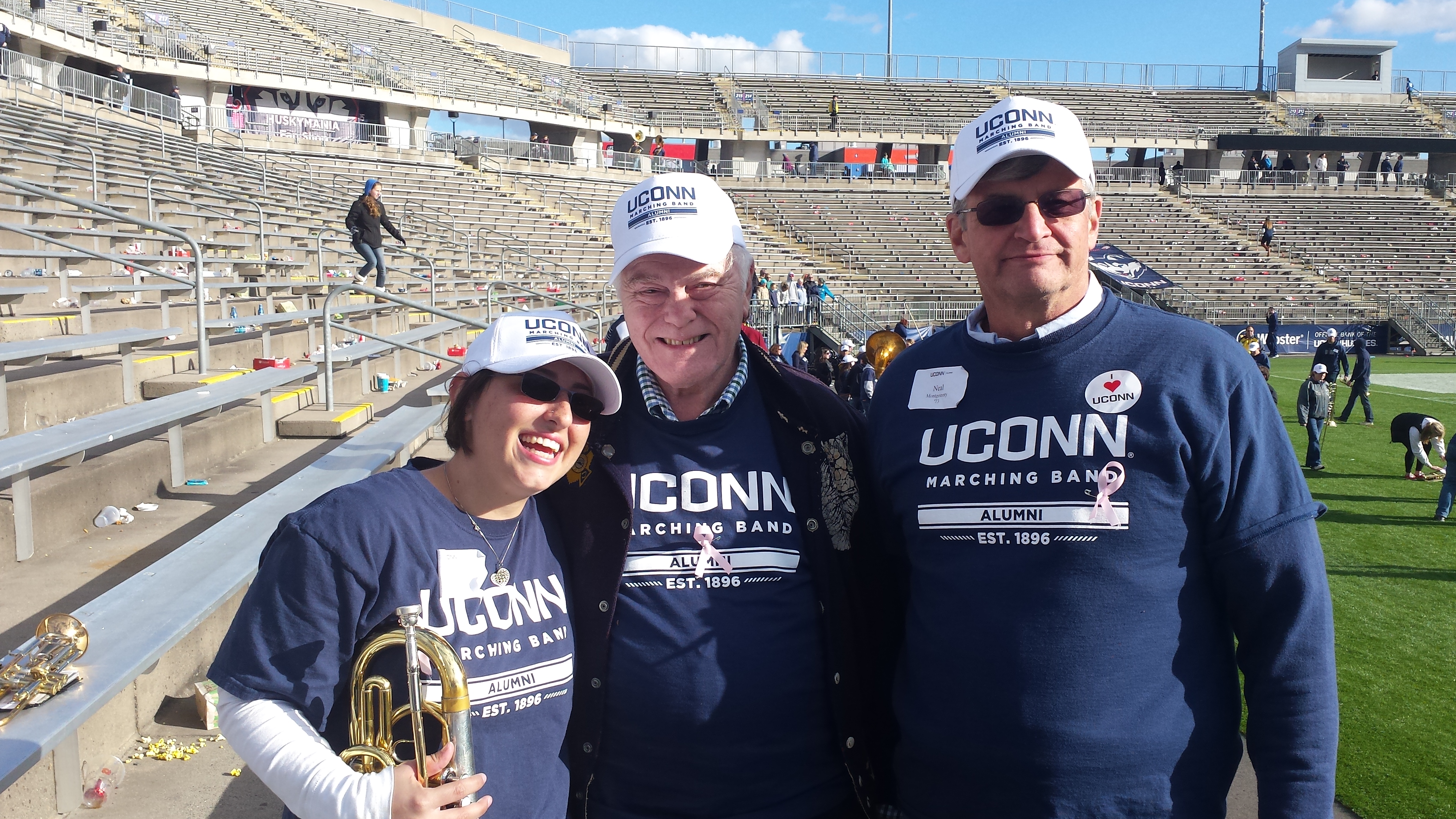
At UConn, we always say “Students Today. Huskies Forever.”  And on top of that, when you’re in the UConn Marching Band, you’re part of a family. These values are becoming more and more meaningful to me each passing day. It’s really quite true! Every year, alumni return for the homecoming game. This year there were nearly 160 alumni band members sharing the field with early 320 students during half time. What a spectacle! And every person was beaming with pride. So you can probably imagine, the passion and excitement about being back was absolutely contagious!

Everyone was standing tall representing their affiliations by wearing their memories on their clothing. We collectively relived our college experiences by fondly sharing stories and connecting over our similarities.  I was surprised and inspired to meet two alumni brothers of UConn’s chapter of Alpha Phi Omega, a National C0-Educational Service Fraternity, from the 60’s and 70’s who shared with me the lived history of our UConn chapter and explained that “in their day the fraternity and band was life”. I’m glad to see nothing’s changed!

UConn Marching Band alumni and Brothers of Alpha Phi Omega from the decades!

It’s really quite stunning though to be connected to all these people. It showed me that I was part of something that’s so much bigger than the four years I attended college. I saw truly how influential these experiences were so many years later. And for those reasons, I made sure to thank each alumni I met for their contribution and commitment to our school. I know now that they really did pave the way for me to have the best experiences I could. For that I am thankful. For a day (and ultimately forever), we were connected and reunited because of our love and pride for our Alma Mater. There’s something about UConn and I can’t precisely put words to it but it’s remarkable. It’s unbelievably special and I’m so lucky! I was blissfully, happy. It was so easy to be comfortable. To be myself.

So, this is how I knew I was home: for a whole day, I couldn’t stop smiling. My heart was warmed as I was greeted with hugs and “how are yous” more times than I could count. I was boiling over the top with energy and charisma. I felt like my personality clicked back into place almost like a Lego once it’s re-positioned and re-centered. I could breathe again! Like really breathe! A full deep breath of satisfaction. Confidently and securely I knew who I was in that space and it felt good.

I’ll end with this quote:

“How lucky am I to have something that makes saying goodbye so hard” ~ A.A. Milne, Winnie the Pooh

These words rings true now even more so than they did the days and weeks immediately after graduation. You know you’re home when you get there and you effortlessly feel comfortable. You can pick up right where you left off and most of your important friendships are salient enough to overcome barriers such as distance, time, or social media. And I am lucky. I’m lucky to be challenged with visiting a place I love so much because I know it’ll be both so wonderful to go back and so difficult to leave. I know that each time I leave and look back I’ll have learned something new about why UConn was so meaningful to me.

A good friend said it best. She said, “you can’t miss something if you never leave”. So, in the face o20151017_132544f all my lamenting, a small part of me is appreciative for the opportunity to miss this so much. Because I know I can always go back home.

What I Payed Attention to in Class (Other than Class)

Lately, every time I leave class I’m in a bad mood. When I walk home I call a friend and typically I spend the next twenty minutes complaining. When finally do stop I realize I’m exhausted. I am tired from the daily narrative that consists of me explaining, perhaps defending, why I hate this school. Every day. I find myself talking faster and faster and with each new iteration of that day’s rationale, I puzzle through this roller coaster called graduate school. Ultimately I slam the breaks and reach this abrupt conclusion as arrive at the end of my monologue: “I just want to quit”.

For vulnerability (and positivity) sake, I don’t hate EVERYTHING at this school. And while I’m apprehensive to admit it the redeeming qualities of my experience thus far may be reasons I don’t actually quit. However, overwhelmingly the biggest reason for not wanting to quit is having to explain my rationale to other people. I realize that my quitting probably won’t influence their lives nearly as much as it will influence mine. I do realize this.

You see, I haven’t yet overcome a fundamental tendency of mine to measure my self worth by my perception of other’s approval of my accomplishments. It’s always been about moving forward, about being better, about doing better, about doing too much. Even the choice to come to this school wasn’t a choice. It was the obvious decision I had to make based on the pressure I felt I would endure trying to explain why I picked UConn despite this competitive, glamorous alternative. How could I explain that? And then, everyone’s so quick to respond to my complaints by offering, “this was your choice”. First, NOT HELPFUL! Second, was it really? Was there a choice or were there hours of conversations that backed me into a corner so the decision was forced upon me but we lied to ourselves and called it “obvious”? There was no choice. So then, how could I EVER explain that I quit? Or even, let’s back up, how could I explain why I want to quit? And how could I overcome the feeling that I let so many people down or that I didn’t meet their expectations? For complicating things sake, how do I reconcile that I let myself down or that I didn’t meet my own expectations for myself (regardless of how deeply embedded my personal expectations for myself are reliant on others’ approval)? So that’s where my head is right now. That’s the context for my story today. 

[WARNING: This is about to get messy and uncomfortable. I’m going to privilege being genuine and attending to my emotions in this moment. This will be raw material edited for typos only]

Here we go:

The world of urban education policy is messy. It is always complicated by game changing insertions of race, class, ethnicity, etc. to the conversation. Tonight, I was keenly aware of my positonality in this conversation but even more than that, I was paying attention to who was “tuned in” and who was “tuned out” when certain people spoke in class. It’s been said that in our own classrooms we replay and represent they very systems we critique and try so fervently to reform. I think that’s true but I think we also can’t help but bring our own biases to the table. Instead of suspending judgement in favor of a collective, constructive learning space we allow these ideas to bleed into the conversation. Each of our pervasive thoughts poison the air making every genuine attempt to contribute vulnerable to quick criticism. Once we put the words out there, the way they’re experienced and interpreted is out of our control. So we take risks. We talk about what we know (or what we think we know). We ask about what we don’t. And the conversation moves quickly. Ideas bouncing from person to person. Defensiveness grows taller and stronger as ideas are upheld or squashed by louder more powerful voices that signal to everyone else what we should agree is important and what ideas we should entertain. Some forge ahead while others lag behind. Some voices don’t even make it out of the gate.

In this fast paced intimidating space I felt both inside and outside of the conversation at the same time. It was like I was watching this unfold. It made me uncomfortable. We created and are now maintaining a space where certain perspectives, voices, and opinions spoken from specific individuals are privileged and others are instantly neglected. I felt small and timid. I felt like I needed to defend myself before I started talking. Speaking bluntly, I needed to defend a not subtle implication that because I am white (regardless of my many other minority identities) it wasn’t my place to enter the conversation and my experience (regardless of my preparation, training, or due diligence) wasn’t enough for me to speak knowledgeably about issues related specifically to minority groups. I’m not saying I know their lived experience. I’m not saying my voice is the only one that should be heard. I am saying I deserve to be considered too and not immediately “tuned out” because I’m a white girl trying to say something about race and minority groups.  So as the class persisted, I watched as some voices were elevated and others were depressed. I listened to which statements were engaged with and conversely which were simply acknowledged and then moved past. The stage, the arena, tonight was for certain voices. I watched backs turn and eyes roll. I heard raised voices and aggressive tones garner respect while neutrality and curiosity were overlooked.

For all the times I’ve walked into class feeling like I could do this, like I was good enough, like I could ask good questions my confidence was quickly, and yet again, crushed by an environment that feels like it is only open to certain peoples’, certain voices’, interjections to the discussion. So, yes I hate this! I hate feeling small and having to defend myself. And no, it’s not because I just want people to agree with me. It’s not because I’m not used to my ideas being challenged. It’s because I don’t respond well to competitive environments. I’m my biggest competition and critic. I’m harsh enough on myself. I don’t need to endure it from others too [side note: I also don’t want to hear right now any sass about the “real world” k, thanks]. When I offer my perspective just know I’ve thought about the alternatives and the misconceptions. And so, in spite of the intimidation I feel I speak up. But all too often, my spoke words don’t weigh up. My intentions get misconstrued and easily ripped apart.

Why should I keep trying in this aggressive space? Is it because I have to overcome this to add it to my list of successes? Is it because I don’t value my happiness as much as I value others’ approval?

Today I watched intensely what was happening in my environment. I watched who was respected and heard. I watched whose agency was met with enthusiasm and whose attempt was disregarded. I listened. I observed the dynamics. I was disappointed. I want to quit.

Some Thoughts About National Coming Out Day

Today, October 11th, is National Coming Out Day!

Truth be told, all week I’ve been waiting in anticipation of this day. Actually, I’ve been waiting for  months. But, now that it’s here I’m met with much ambivalence. Mostly I’m challenged with the fact that we have National Coming Out Day at all. This is not an original idea – I realize that. The bottom line is if we didn’t live in a heteronormative society then we wouldn’t need this day. Moreover, why do people who aren’t straight need to come out when straight people are just presumed straight? You want to talk about privilege?!?! So framing this day as a privilege, celebrating that someone “gets” to come out is just so unbelievably frustrating. It’s like EVERY other day of the year it’s not your space, privilege, right, obligation, expectation to come out but today it is? And so coming out becomes yours under whose terms? I don’t need to spell this out but even National Coming Out Day operates under the constraints of the dominant, majority groups. So is it really our day? 

Moving past my rant, National Coming Out Day is also another day that is FILLED with labels. Right? We’re supposed to say “I’m _________” in the vein of solidarity and support. The alphabet soup of the LGBTQIA movement is hard to swallow and the myriad of identities is difficult even for experts to dissect. I star24daa08c97f5b9759ffc1051343da9e3ted considering this more earlier this seek when I saw these three images:9-bi

20150919_213918-1

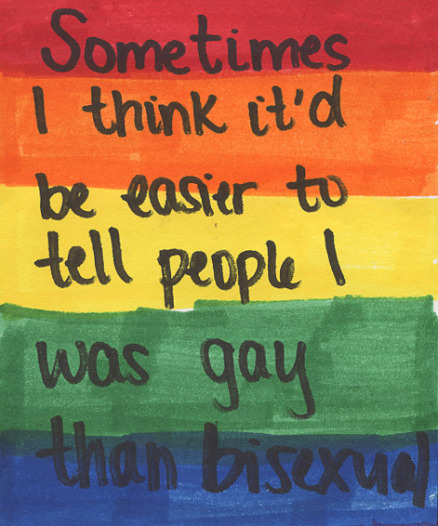
I just wonder, how can we have National Coming Out Day and consider that yet another triumph in the LBGTQIA movement when certain identities are still minimized even within minority communities? Someone who is Bisexual feels like they should just say the’re gay because it would be easier. Someone who is Asexual doesn’t know how they fit into the community. [side note: this Buzzfeed video captures that sentiment in a super compelling way: 15 Poignant Asexual Confessions] And then I saw this on Instagram in reference to National Coming Out Day: “don’t you dare come out as an ally”. First, everyone needs allies. Second, this is about the time I want to smash all labels (and all social media). I’m frustrated! These words mean nothing if they’re simultaneously residing in the realms of discrimination and unity. National Coming Out Day is supposed to be freeing. It’s, to me, a demonstration of how large the community is and an opportunity to find support and connections in an unforgiving, hard to navigate world. But instead, I feel like even National Coming Out Day is also being dominated by a majority group. It’s a day for CERTAIN people in the LGBTQIA community. Others stand to the sideline and grapple relentlessly with their positionality. We question “are our identities valid enough to be recognized on this day?” or “have we struggled enough to deserve to participate in National Coming Out Day?” Here’s where it comes back to labels. We decide the meanings we attribute to these words and then we judge. Why should one person who identifies one way fear so violently speaking their label? Owning their identity? Even on National Coming Out Day these wonderings, these anxieties, are real and for some of us they’re amplified.

[Side note: I’m not in any way attempting to minimize any one person’s struggle or journey. I realize that coming out as anything is challenging or even terrifying. I’m not even talking about who people love or who they’re attracted to. I’m talking about labels. And in doing so, it feels like I’m taking a huge risk.]

Labels can give us closure but they can also really harm us. I’m thinking here about a medical or mental health (not sure why I made that distinction – ugh society) diagnosis. These labels follow us and while in some contexts they allow us to receive the services and interventions we need to be our best selves in other ways they limit our potential by attaching an inescapable stigma that lingers long after we’ve felt that we’ve triumphed and moved on or overcome one of our many hurdles. Similarly, in the LGBTQIA community labels speak volumes! Among others, they indicate the level of struggle you’ve endured, who you are sexually or romantically attracted to, and who you love.

I haven’t talked yet about the third image I saw. It said “Be Yourself”. I liked this one the best but I also wish that we didn’t need motivational pictures on social media to remind us to be ourselves. I wish there wasn’t a day where it was okay to proclaim loudly who you really are and then attach a label to it so other people can make their judgement about you or know how to categorize you. I hope that tomorrow people can still proudly and loudly be exactly who they are and how they identify without any stipulations. Our labels are both constricting and empowering when we first speak our truths. However, once society gets a hold of them, we’re leaving our words to be interpreted differently with each repetition of who we are. The threat of misinterpretation makes me breathe too quickly. On National Coming Out Day I can choose my label but I cannot choose its connotation. That’s scary.

National Coming Out Day reminds me there’s still a long way to go in the LGBTQIA movement. We’ve had victories large and small but the whole idea that we need a day for people to say who they are makes me wonder, if I don’t come out today will I have missed my chance?

And now, I’ll resort to homework and hiking today to avoid this social media mess of labels and many, overwhelmingly colorful displays of false or fleeting approvals (which I interpret with a certain degree of insincerity) to someone’s real, breath taking proclamation of self.

Getting Back on Track

Earlier this week, my friend asked me “how are you?”. Her question wasn’t surprising or out of the ordinary but it got me thinking. In typical fashion I answered “I’m fine. Busy but it’s all good” and then the conversation moved on. I realized that one of the reasons I was “good” was because I hadn’t given any time to myself in the past week. Even running this week was an obligation not an escape. I was “good” because in the midst of midterm assignments and more reading than I could imagine I so easily reverted to a space of neglect for myself and my needs. It’s easy for me to get caught up in my work and ignore myself. A lot of the time, I do this intentionally.

I noticed my normal state of complacency and “fine” (synonymous with good) could easily be attributed to my just going through the motions, busy, chaotic, “doing too much” life and I wasn’t respecting myself in the process. For example, this whole week I was sick and I ran more miles than the week before and went to the gym twice. While I was so busy it didn’t feel overwhelming; it felt good and really comfortable. I could stumble along appearing to be reluctantly doing my obscene amounts of work while truthfully appreciating the mountain of reading for the excuse it allowed me. I made a choice to put my energy into anything but myself. I make that choice often. So the lamenting, appearing to be procrastinating, the #gradschoolprobs tweets, they were all a front because I seriously was enjoying the machine-like week I was having. Not because I liked all the work but because for a week, I didn’t have space to feel anxious, to overthink, to consider all the alternatives and interpretations.

I turned the “me” part of my brain off and then I could breathe again. 

Then I remembered, I also hadn’t written in my journal, talked to friends, blogged, posted on Instagram (as much), or had coffee with friends during this time. This project is about accountability and taking those jumps into the unknown and seeing what happens. So now, I’ll get back on track!

Here’s what I’m going to try to do differently this week:

  1. Take breaks! This picture is taped to my desk. Too often I glance at it quickly or cover it with books while I’m doing work. So, instead of staring a the page and then going back to work I’m going to pick an activity and do it.
  2. Make realistic to-do lists. My to-do list never has anything for me on it. It’s pages long and always has upwards of 10 things that need to happen. Things often feel urgent for me and so, if it’s on the list it’s getting done and the idea of stopping before it gets done isn’t an idea I readily entertain. So, I’m going to break up my master to-do list into bite sized chunks. I’m going to practice prioritizing and to make it easier, I’ll frame it as a different type of micro-managing of my time.
  3. Run only if I want to. This summer I got into the various running challenges on Map My Run. At first it was fun and motivating but I’m not the kind of person who settles for less when I know I can do more so this became less of a fun challenge and more of a necessity (do I need to remind readers I have OCD?). So now, I’m struggling to maintain my weekly mileage and something that once made me feel victorious and strong now feels more like an obligation and just another thing I need to do each day. I want to enjoy running again and I don’t want to feel like a chore or something I can check off just to say that I did it. It’s easy for me to get caught up in how much I did and continue to push myself. I don’t settle for less than I know I’m capable of. I need to consider what I may be missing or losing by cultivating this mindset for running and for my other responsibilities.

Like I said, it’s easy for me to ignore myself. I’m often stranger to myself. When people ask me what I want to do with my life, I typically start with explaining what I’ve done since I don‘t have an answer for them. My measure of myself cannot be contingent on the compilation of what others perceive to be my successes. I need to find space to get to know who I am outside of the quantifiable, resume worthy aspects. I didn’t do that this week but, next week is another chance to do something different and in the meantime I’ll appreciate the opportunity to learn from my missteps and to practice better intentionality moving forward.